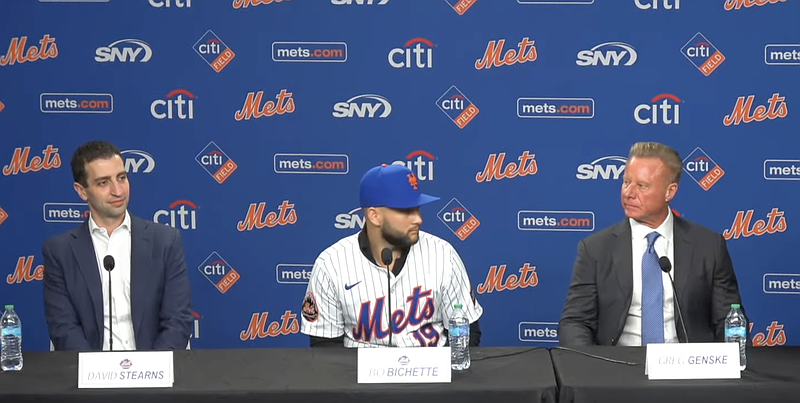
Bo Bichette looks to his agent when asked if his contract should be viewed as a one-year deal. (Photo credit: SNY)
There was a mildly uncomfortable moment Wednesday when the New York Mets held their introductory press conference for Bo Bichette.
Bichette signed a three-year/$126 million deal to join the Mets last week, choosing that over a reported seven-year/$200 million offer from the Phillies. One of the reasons that the Mets offer appealed so much to Bichette is that it includes the chance to opt out after the 2026 or 2027 seasons and return to free agency. So, in essence, this could prove to be a one-year deal. If Bichette has a great season in 2026, he could opt out and return to free agency next winter, still on the right side of 30 and without a qualifying offer attached to him.
Jon Heyman of The New York Post asked Bichette about this dynamic Wednesday afternoon, and the two-time All-Star kind of short circuited and looked to his agent, Greg Genske, to answer for him:
Lmao yes https://t.co/cFTBBS8wlk pic.twitter.com/LlJVPHyKVf
This clip doesn't show Genske's full answer, but he went on to say the following.
"Jon, thanks for your question. Good afternoon, everybody. We had a lot of conversations about the different structures of the deal, and Bo had his choice of long-term deals, shorter-term deals, opt outs. I think the important thing to know here is he's coming here because he's committed to this team. His priority was finding a place where he felt like he could get better as a player, and have a chance to compete for championships. And he's making this commitment to come here, and hopefully for a long time. Certainly, it was important, given his age — as you mentioned, Jon — that we preserve optionality. But his commitment is to the Mets. His desire is to be here. His desire is to compete for championships here."
The reality is that Bichette signed a deal that basically is only a year-to-year commitment. If he gets injured or struggles, he won't opt out of the deal next offseason. But if he has a very good season — even if he loves New York — he's going to opt out and try to find the highest long-term bid next winter. That bid could come from the Mets, but it also could come elsewhere.
If you need a recent example of this, Alex Bregman signed a three-year/$120 million deal with the Boston Red Sox last offseason. Because he had declined a qualifying offer from the Houston Astros, the Red Sox also had to give up second and fifth-round picks in the 2025 MLB Draft, along with $1 million in international bonus pool money. Even though he was limited to only 114 games, Bregman opted out after posting an .821 OPS, and ultimately left in free agency to sign a five-year/$175 million deal (which includes $70 million in deferrals) with the Chicago Cubs. The Red Sox, meanwhile, were left empty-handed.
That's the risk in signing these type of deals. Certainly, the Mets are better with Bichette, and the Phillies are worse off for not having him in 2026. But the possibility exists of Bichette being one-and-done in New York, just how Bregman was in Boston.