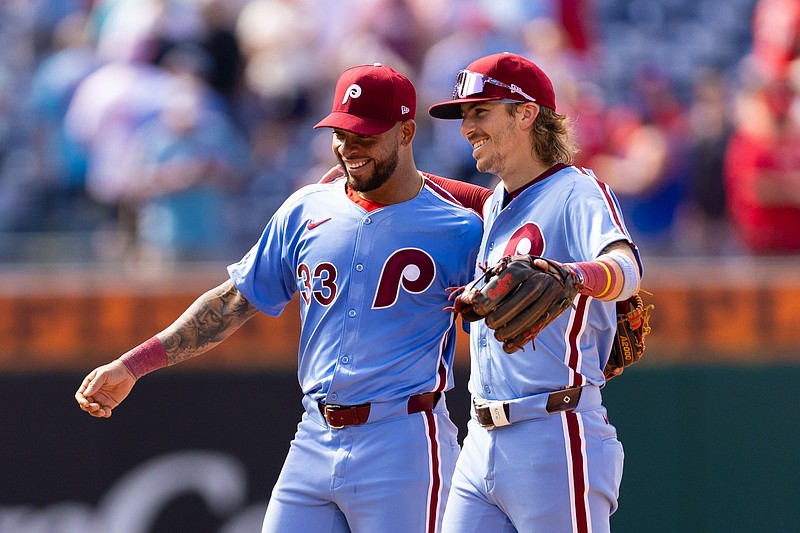
May 23, 2024; Philadelphia, Pennsylvania, USA; Philadelphia Phillies shortstop Edmundo Sosa (33) and second base Bryson Stott (5) celebrate a victory against the Texas Rangers at Citizens Bank Park. Mandatory Credit: Bill Streicher-USA TODAY Sports
ORLANDO, Fla. -- If Dave Dombrowski weren't a baseball executive, it's not a far stretch to assume he would have a successful career as a history professor.
Case in point was Day 2 of the Baseball Winter Meetings. On a day when the Phillies got a lot done - namely re-signing Kyle Schwarber and adding another year onto the contract of manager Rob Thomson, Dombrowski's most detailed answer to a question brought us back to the mid 1970s and early 1980s for context.
Before we revisit that history lesson, there needs to be a reminder that the Phillies used three platoons in the second half of last season, mostly with success.
Left field. Right field. Second base. all three positions, when viewed simply as a position of productivity and not necessarily through the lens of the individual players, were upgrades over what the Phillies initially had planned for those three positions when the season began.
Once Bryson Stott made a change to his swing in mid-July, he and Edmundo Sosa made second base a weapon in the Phillies lineup.
IT'S A THREE HOME RUN GAME FOR EDMUNDO SOSA! pic.twitter.com/ADkUvrbNqm
After acquiring Harrison Bader at the deadline, what started as a three-man platoon for two spots, ultimately became a four-man platoon on the corners that worked out very well. Max Kepler and Brandon Marsh played against righties while Nick Castellanos and either Otto Kemp or Weston Wilson played against lefties.
One would think it's not ideal to look at a roster and say you want a bunch of platoons, but the Phillies got the most out of the players they had in those positions down the stretch.
But the reality of the game today is, you can't have a star - or even a very good player - at every position, because of player salaries.
This is when Professor Dave began his lecture by referencing the Cincinnati Red of the mid-70s.
"We still face financial decisions, right? I've said that the Big Red Machine ... I just watched some nice things on the MLB Network about them - I don't know that there's any club that could afford the Big Red Machine in today's world," Dombrowski said. "I mean when you start looking at (Johnny) Bench, and (Pete) Rose, and (Joe) Morgan, and (Dave) Concepcion, and (Tony) Perez and George Foster and (Cesar) Geronimo and (Ken) Griffey and they had some decent pitchers, well, they're probably all $30-$40 million a year players, right? It's hard to get that type of team put together."
The Big Red Machine, 1976 pic.twitter.com/VaRyM8zR2F
And he's right. Bench, Morgan and Perez are Hall of Famers. Rose would have been had he not gambled on baseball. (He still might be in a few years, now that he's eligible again).
Each of them would have been $30 million players.
Foster was an MVP winner, a runner-up and had two other top-six finishes, - so he'd probably be in the $25 million range.
Concepcion was a nine-time All-Star. Griffey was a three-time All-Star in the late 70s. Easily $20 million each.
Geronimo wasn't a great hitter, but he was an excellent centerfielder defensively and had a couple of 4+ WAR seasons.
The point is, you can't put teams together like that these days. The closest is the two-time defending champion Los Angeles Dodgers, and they still have some holes.
"The game has changed throughout the years," Dombrowski said. "And we've really become aware of platooning much more than we used to, so you try to give yourself the best chance to win. A lot of times you may like a player still, but the other player, you think gives you a little bit better chance to win versus that left-handed pitcher or that right-handed pitcher.
"We didn't used to do that years ago. It used to be, 'O.K., go play.' Now you have platoons. Almost every organization in baseball does that nowadays. We weren't unique in that regard. (We) try to get that little advantage that may make a difference."
Which is why on Monday, Dombrowski talked about platoons involving Brandon Marsh and Otto Kemp for next season. He also suggested Kemp could platoon some with Justin Crawford, or that if Gabriel Rincones Jr. were to make the team, how he would need a right-handed outfield bat to platoon with him.
It's a good bet that if both Sosa and Stott are back in 2026 that the Phillies will plan to use them the same way they did in 2025.
The idea is to think of platoons as one position, and not two players. For that, Dombrowski had another historical example hearkening back to when Earl Weaver used platoons to his advantage with the Baltimore Orioles.
"Very few people remember John Lowenstein and Gary Roenicke," Dombrowski said. "They did that then. Not many people were doing those type of things. Now many more people do. They had 35 home runs in left field and won a world championship and everybody was like, 'How can they win like that?' Well. they got 35 home runs and 100 RBIs from the left field combination."
To be exact Lowenstein and Roenicke combined for 34 homers and 124 RBIs as a left field platoon for the Orioles in 1983, the year they beat the Phillies in the World series.
John Lowenstein - 10/12/1983
🍁 Postseason 🍁 pic.twitter.com/5BirmTEClO
They combined to slash .270/.348/.479 for an OPS of .827.
In a story I wrote yesterday about the Phillies outfield, I pointed out that Marsh and Kemp had this slash line combined last year:
.289/.349/.478; .827 OPS
Look similar?
As such, don't be surprised if the Phillies look to have platoons in place for at least two positions, if not three next season as well.
And take this as one final nugget and stash it away - any time Dombrowski decides to offer a historical comparison, it's usually done with a purpose. He's telling you something about his current team.
Like any good professor, he's going to make sure you're paying attention and to do that, he's going to give you all the information you need without actually giving you the direct answer.